Over our years in school we have learned many things about the human body, but I have retained very little. Being asked the question "What do you know about the human body?" I simply draw a blank. Trying to reach into my head I will now try to remember... What I know about the human body.
First, I know about the heart from 5th grade science and from taking a lifeguarding course over the summer. I know that the heart is a four chambered organ, a left and right ventricle and then the left and right atrium. I know that the heart brings in and then pumps out blood, something that is essential.
Secondly, I know that the human body is made up of millions of cells, of which we studied this year and can be seen in other blogposts. Because we are eukaryotic, our cells function differently depending on where they are and what functions they serve.
I know about many of the different organs in the body. I know that the esophagus, small intestine, large intestine, stomach and anal make up the digestive system (probably a few more...) I know that the lungs (two of them) are necessary for breathing and bring in oxygen and release carbon dioxide and other wastes. I know that your brain, besides the heart, is the most important organ in the body and has a nerve attaching itself to your back, and if you damage the nerve in anyway (such as breaking your back) you will most likely become paralyzed or some other form of permanent damage.
I know that, arteries carry blood to the heart (oxygen-deprived) and veins from the heart to other parts of the body.
I know that humans are different, and are deemed superior, because we have opposable thumbs which enable us to move and pick up things that no other species can (except monkeys, but they are very similar to us)
There are many more things that I know about the human body, except that I am drawing a blank on them now and I don't have enough room to write every thought I have.
Showing posts with label Cells. Show all posts
Monday, May 9, 2011
Wednesday, March 9, 2011
Genetic Cloning
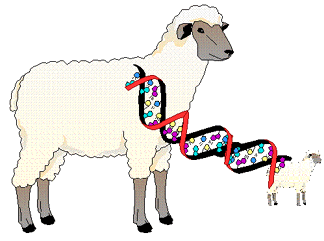
This process is both new in the science field and greatly debated. Although few mammals have been successfully cloned, the first being Dolly in 1997, the topic of cloning animals, and humans is greatly debated. The pros of this cloning is that is creates no need for reproduction, you can just clone yourself, and if you have a good immune/health system, cloning yourself could create "the perfect race". This would be great because disease numbers would go down (almost to non-existant) and life expectancies would rise drastically. Also, if we were to clone plants and animals, we could have perfectly balanced food all of the time. The cons for cloning are also a good side. If the human race were to constantly clone DNA, it would lessen the diversity in genes, which would not allow the human race, and other animals/plants to stop adapting. This would be terrible for everyone, because adaption is necessary in life.
In a recent study, it shows that it is possible to take fossils of extinct species and clone them, making them not extinct anymore. This is done by taking things such as bones from a museum, ancient hair and other cellular items and doing a Somatic Cell Nuclear Transfer with them, and then putting them in a surrogate similar to the species itself. This idea, although completely remarkable, brings up serious problems. If extinct animals were to come back, such as mammoths and dinosaurs, it would seriously disrupt the ecosystem already strained today. With a "new" organism fighting for food comes, the ecosystem is greatly altered, changing the way of life for many animals. http://www.cbsnews.com/stories/2010/01/07/60minutes/main6067594.shtml
Genetic cloning is a remarkable study, and seems only used in fiction novels. This is real, and has potential to change the way of life itself completely.
Sources:
- http://www.arhp.org/publications-and-resources/patient-resources/printed-materials/cloning
- http://learn.genetics.utah.edu/content/tech/cloning/whatiscloning/
Wednesday, February 23, 2011
Laron Syndrome: A key to cancer prevention?
In a current event article by MSNBC, there is a group of Ecuadorian people with the extremely rare disease Laron Syndrome. This disease results in dwarfism, affecting only two-hundred fifty people world wide. In the genes, there is a mutation in the gene that codes the growth hormones in the body, affecting the growth of that particular person with Laron Syndrome. Because of the mutation, people with this disease have low levels of insulin-like growth factor 1 (IGF1). Why is this disease so special? The Ecuadorian people, because of this disease and low levels of IGF1 are nearly immune to both cancer and diabetes. This is because people with high levels of IGF1 are more at risk for cancer, meaning that they are growing at a faster rate (IGF1 directly influencing the speed at which you cells grow). People who use IGFI as a "steroid" (to grow bigger at a faster rate) are also more likely at risk for cancer and other diseases. (Link)
This article shows the beginning of a potential cure to cancer, if it were possible to lower the levels of IGF1 in high risk people, of all people in general, the risk of cancer would be very, very slim. This article was very uplifting, stating that you don't have to have this disease just to have low levels of IGF1, you can have low levels and not have the disease at all, just be pretty much immune to cancer!
Although this is a good sign, and scientists will further discover ways to lower normal people's IGF1 levels, there is always a risk with playing with someone's genes. If scientists thought that they could change the coding of a person's genes for the sake of making someone immune to cancer and diabetes, one slight mistake could result in difficulties for the rest of their lives, and easily be fatal for that person.
Overall, this article was extremely interesting and informative about the problems and solutions today in cancer research.
For more information, here is the link to the actual article:
http://www.msnbc.msn.com/id/41632071/ns/health-aging/
Monday, October 25, 2010
Cell Community Comparisons
This week for our blog post, we had to make a Glogster comparing a cell community to any community that we wanted. I chose the New York Yankees, because I believe their team and organization make a great comparison towards eukaryotic cells. Click on the blog below to see this glog.
Wednesday, October 13, 2010
Bad Bacteria: Tuberculosis
Of all the bacteria in existence, almost 99% are good, helpful bacteria. The other 1%, however, is harmful towards the body and can make you very sick, sometimes fatally ill.
One type of harmful bacteria is Tuberculosis, caused by the Mycobacterium tuberculosis bacteria. This disease is transmitted through the air, but is nearly impossible to catch with one social interaction with someone infected. If you are exposed constantly, though, you could catch this disease. 90% of the people who are infected with the disease will stay inactive, meaning they still have the bacteria in them, but they show no signs or symptoms and can't spread the disease. These people, however, can become active and become sick. This means that the remaining 10% have the active bacteria can result in serious sickness, even death.
Tuberculosis is an infection that spreads in your body through the lymph nodes and bloodstream. Although these bacteria can travel anywhere within the body, they are most likely to end up in the lungs. These bacteria kill the tissue in the organs they infect.
Symptoms of TB include: A bad cough that lasts 3 weeks or longer, weight loss, coughing up blood or mucus, weakness or fatigue, fever and chills and night sweats. Although TB can be fatal, there are ways to treat it. To treat TB, usually you take antibiotics ranging from six to nine month to destroy the disease, and the differences in antibiotics depend on your age, overall health, drug resistance, form of TB and the infected location in the body. People who have inactive TB can also take these antibiotics to prevent it from becoming active.
Mycobacterium tuberculosis: Mycobacteria are waxy celled, pleomorphic rods, which range from 2-4 micrometers in length, and .2-.5 um in width. These bacilli cells also have a high concentration of lipids in them, called mycolic acids. Because of this, they have a resistance to many antibiotics. Also, these lipids are hydrophobic and affect the permeability, allowing of liquids or gases to pass through, in the cell wall. These are found in habitats such as water or soil. This specific TB causing bacteria has been causing harm since before human times. Evidence shows that this transferred over to humans through cows in 8000-4000 B.C., through milk consumption. For more information on this bacteria, go to this website
Sources:
http://www.webmd.com/lung/understanding-tuberculosis-basics
http://www.nlm.nih.gov/medlineplus/tuberculosis.html
http://tinyurl.com/27rmhuw
http://www.microbiologybytes.com/video/Mtuberculosis.html
http://www.textbookofbacteriology.net/tuberculosis.html
Subscribe to:
Posts (Atom)