Showing posts with label Genetics. Show all posts

Thursday, April 21, 2011

My Family's Genetics

Tongue Rolling
In biology, we tested multiple genetic traits on our families, to see if our parents (and in some cases ourselves) were Homozygous Dominant, Heterozygous or Homozygous Recessive. When we asked our family, we tested on the following traits:

1) Tongue Rolling
2) Attached Earlobes
3) Hitch Hiker's Thumbs
Attached Earlobes (bottom)

4) Widow's Peak

When I asked my mom, my dad and my sister, I found the following chart:
(+ if yes, can do it/has it, - if not)
                       Family Genetics
Trait                Mom      Dad     Phoebe     Megan


Hitch Hiker's Thumb
Tongue Rolling          +         +         +           +


Attached Earlobe        -         -          -           -


H.H. Thumb             +        +          +           +


Widow's Peak          -        -          -            -


As you can see, from this chart, all of the traits that we tested were the same throughout my family. This is interesting because we are all the same, and because my mom and dad shared the same trait, because of genetics and we (my sister and I) being their children, we automatically would share that same trait.

From a source, I found the following data about if these four traits were dominant or recessive:

1) Being able to roll your tongue: Dominant
2) Having attached earlobes: Recessive
3) Having a hitch hiker's thumb: Recessive
4) Widow's peak: Dominant

Because of this and from the data that I collected from my family I can determine the following:
- For tongue rolling, because it is dominant and both of my parents can roll their tongue, they are either homozygous dominant (RR) or heterozygous (Rr), we cannot confirm that from just this data.
- For earlobes, because having an unattached earlobe is dominant, both of my parents have unattached earlobes, they must be either homozygous dominant or heterozygous.
- Having a hitch hiker's thumb is recessive, of which both of my parents have. Because both of their children have a hitch hikers thumb both must be homozygous recessive (rr), because if one had a dominant gene in them, one of their offspring would not have a hitch hiker's thumb
- Having a widow's peak is dominant, and because both of my parents don't have a widow's peak, they must be homozygous recessive.

From this data we can conclude for sure if a parent is homozygous recessive, but not the difference between homozygous dominant and heterozygous. This is because you only need one dominant pairing for a person to have that trait, so, the person could show the trait and be Rr or RR, you simply don't know until you have kids, of which if one doesn't show the trait, you know you are Rr. This is not the case for my family, because when my parents had a trait, me and my sister would both have the trait, thus determining that we can't tell whether my parents are Rr or RR.

For more information on dominant vs. recessive genes see this link:
http://www.blinn.edu/socialscience/ldthomas/feldman/handouts/0203hand.htm

Wednesday, March 9, 2011

Genetic Cloning

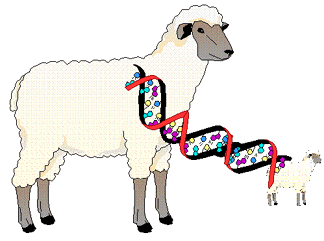
If you think of futuristic discoveries, the idea of cloning yourself must come to mind. What if I had another person exactly like me roaming around on the earth? Although many people might think this, few people actually know what genetic cloning is. Genetic cloning is the creation of an organism that is an exact genetic copy of another, meaning that they have the same genetic makeup. Cloning is also an asexual form of reproduction, meaning that the offspring comes from one parent rather than the normal (for humans) two. In humans, and mammals in general, this idea of asexual reproduction is unnatural, so it must be done forcefully and unnaturally. There are many ways to go about this, but the most known is Somatic Cell Nuclear Transfer (SCNC).  This procedure creates an exact clone or genetic copy of an individual. A somatic cell is any cell in the body other than reproductive cells. The difference between reproductive cells and somatic cells is that somatic cells have two complete sets of chromosomes, while reproductive cells only have one (awaiting for the other pair to make offspring). A SCNC takes the nucleus of a somatic cell (containing all of the DNA in that individual) and places it in an empty egg cell. This creates a fertilized egg. Once the egg has created an embryo (in a petri dish), it will be placed into a surrogate mother until ready for birth. Once this organism is developed, it is a clone of the individual who donated the somatic cell!

This process is both new in the science field and greatly debated. Although few mammals have been successfully cloned, the first being Dolly in 1997, the topic of cloning animals, and humans is greatly debated. The pros of this cloning is that is creates no need for reproduction, you can just clone yourself, and if you have a good immune/health system, cloning yourself could create "the perfect race". This would be great because disease numbers would go down (almost to non-existant) and life expectancies would rise drastically. Also, if we were to clone plants and animals, we could have perfectly balanced food all of the time. The cons for cloning are also a good side. If the human race were to constantly clone DNA, it would lessen the diversity in genes, which would not allow the human race, and other animals/plants to stop adapting. This would be terrible for everyone, because adaption is necessary in life.

In a recent study, it shows that it is possible to take fossils of extinct species and clone them, making them not extinct anymore. This is done by taking things such as bones from a museum, ancient hair and other cellular items and doing a Somatic Cell Nuclear Transfer with them, and then putting them in a surrogate similar to the species itself. This idea, although completely remarkable, brings up serious problems. If extinct animals were to come back, such as mammoths and dinosaurs, it would seriously disrupt the ecosystem already strained today. With a "new" organism fighting for food comes, the ecosystem is greatly altered, changing the way of life for many animals. http://www.cbsnews.com/stories/2010/01/07/60minutes/main6067594.shtml

Genetic cloning is a remarkable study, and seems only used in fiction novels. This is real, and has potential to change the way of life itself completely.


Sources:
- http://www.arhp.org/publications-and-resources/patient-resources/printed-materials/cloning
- http://learn.genetics.utah.edu/content/tech/cloning/whatiscloning/

Monday, February 14, 2011

Lung Cancer


The Cell Cycle. Every living this has it, necessary to grow and simply be alive. The Cell Cycle is a very delicate process, any malfunctions and serious, fatal things could happen to any living organism. Within the cell cycle, there are genes that keep the cell cycle “in check” from not going to fast and producing an unnecessary amount of cells. These genes are called tumor-suppressors and proto-oncogenes. When these are not working or mutated, an excessive amount of cells will occur. If this mass is a mass of mutated cells, the outcome will most likely be cancer. Cancer is a terrible disease that many people have heard of and have dealt with within their families.
Cancer is a broad statement; there are many types of cancer. One of the most common types of cancer is lung cancer. Lung cancer is a carcinoma; cancer that begins in the skin or in tissues that line or cover the body organs. Lung cancer forms in the tissues of the lung. Lung cancer begins when there is a genetic alteration in your cells, and there is a lack of equilibrium between proto-oncogenes and oncogenes. Oncogenes are a mutated form of proto-oncogenes and make the cell cycle go faster. When the cell cycle goes faster, a mass of genetically mutated cells are produced in the tissue of the lung causing malfunctions in the lung itself.
Lung cancer itself can be broken down into two types, Small Cell Lung Cancer and Non-Small Lung Cancer. These two types are diagnosed based on the size of the cells and how they look under a microscope.
Small Cell Cancer (SCLC) is much more rare than Non-Small Cell, only about 15% of cases are Small Cell. Within SCLC, there are three different types: small cell carcinoma (oat cell cancer), mixed small cell/large cell carcinoma and combined small cell carcinoma. Most SCLC cases are oat cell. SCLC is the most aggressive form of lung cancer compared to the other type. It is mainly caused by smoking and starts in the bronchi (breathing tubes) in the center of the chest. This type of lung cancer grows quickly and produces large tumors. Because SCLC grows so quickly, it also metastasizes rapidly to other parts of the body including the brain, liver and bone. Metastasis is when a part of a cancerous tumor breaks off from the original tumor and spreads to another part of the body, spreading the cancer. When you have SCLC, there are many symptoms that come from it, including bloody sputum (spitting up blood), chest pain, coughing, loss of appetite, shortness of breath, weight loss, wheezing, facial swelling, fever, hoarseness or changing voice, difficulty swallowing and weakness. Once the doctor diagnoses SCLC lung cancer, it has most likely spread to other parts of the body, most often the brain.
Because SCLC spreads so quickly, little treatment can seriously help the disease. The treatments used to help SCLC consists of chemotherapy and for extensive SCLC a combination of chemotherapy and radiation treatment take place. Chemotherapy is using drugs to kill cancer cells and stop new ones from growing and is often used when the cancer has spread. Chemotherapy is also used to help relieve the cancer pain when it has spread to the bones. Radiation therapy is powerful x-rays or other forms of radiation to kill cancer cells. This treats the cancer and helps relieve symptoms. SCLC is a very deadly form of cancer and only 6% of people with it are still alive after five years of the diagnosis. With treatment, most people can often prolong their life span from six to twelve months. To prevent the risk of lung cancer, simply stop smoking or never start smoking.
Non-Small Cell Lung Cancer (NSCLC), although less fatal than SCLC is still a very harmful cancer. Between the two types of lung cancer, NSCLC is the most common. Within NSCLC there are three types: Aden-carcinomas, found in the outer area of the lung, Squamous cell carcinomas, usually found in the center of the lung by the bronchus, and large cell carcinomas, which can occur in any part of the lung. The causes of NSCLC consist of environmental factors: smoking, second-hang smoke, high levels of air pollution, poor drinking water and working with asbestos, products using chloride and formaldehyde. Symptoms for NSCLC include: a cough that doesn’t go away, coughing up blood, shortness of breath, wheezing, chest pain, loss of appetite, losing weight without trying and fatigue.
Non-Small Lung Cancer spreads much slower than Small Lung Cancer, and can be treated with much higher levels of success. Treatment depends on the stage of cancer, but surgery is most often the first line of treatment for patients that has not had the cancer spread beyond the lymph nodes. When having surgery, the surgeon would remove one of the lobes of the lung (lobectomy), a small part of the lung (wedge or segment removal) or an entire lung (pneumonectomy). Although surgery can be a successful treatment, some patients need chemotherapy, laser therapy or photodynamic therapy (using a light to activate a drug in the body which kills cancer cells).
Depending on the stage of NSCLC will determine the expectations there will be on being cured. Stage I and II NSCLC can be cured with surgery, which has a 50% chance of being completely cured. Stage III NSCLC can be cured in some cases and stage IV is almost never cured, and treatment can be used to extend and improve the quality of life.
Lung Cancer is a very serious disease and in 2010 in the United States, there were 222,520 new cases and 157,300 deaths. Lung cancer is just one of the many different types of cancer, a disease that effects so many lives and families annually. Even the smallest preventions should take place; don’t smoke. If we can lower the amount of pollution in the air and lower the amount of smokers, the amount of deaths taking place due to lung cancer will most likely also lower, helping so many families around the world.


Sources: